
TL;DR: Modern death occurs in sterile, institutional settings, often with a television as a constant, distracting presence. This medicalized approach prioritizes protocol over human connection. We must reclaim the dying process, shifting focus from technological intervention to personalized, compassionate, and human-centered support for patients and their families.
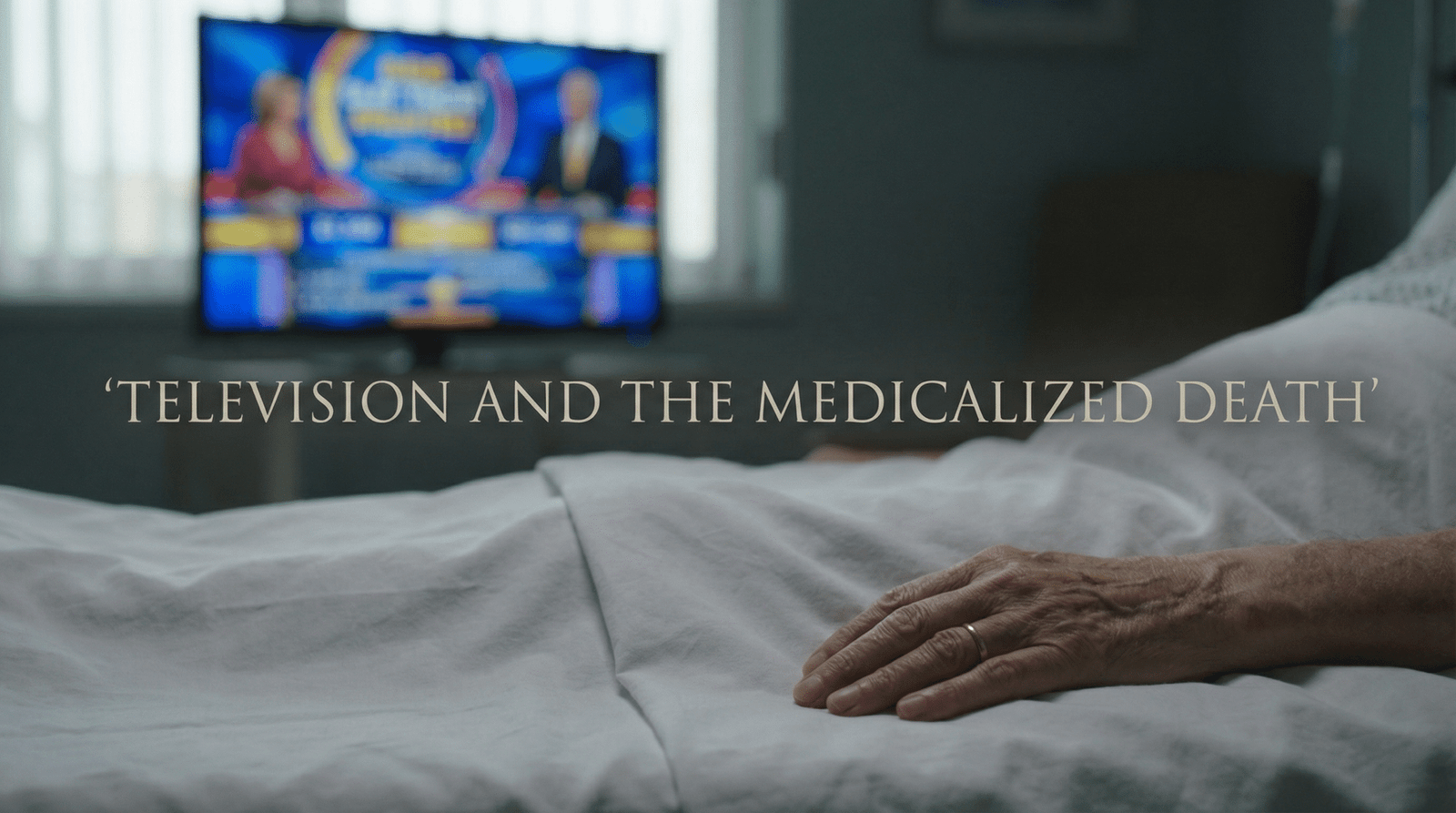
The television is always on. In hospice rooms across America, it flickers through daytime game shows, evening news cycles, and late-night movies—a constant companion to those approaching life’s end. This ubiquity of screens in spaces designated for dying represents more than mere convenience or entertainment. It reflects a broader transformation in how Western society manages death itself: through medicalization, institutionalization, and a peculiar kind of ambient distraction that fills the hours between diagnosis and departure.
How Did Death Move From Home to Hospital?
Until the mid-20th century, death was predominantly a domestic event. People died at home, surrounded by family and community, in familiar surroundings where the rituals and rhythms of daily life continued around them. Hospitals, until the early 1900s, served primarily as charitable institutions for the destitute—places associated more with poverty than healing.
The transformation began gradually in the early 20th century and accelerated dramatically after World War II. By the 1950s, hospitals became the primary location of death in America. By 2014, approximately 37% of patients died in hospitals, 23% in nursing homes or long-term care facilities, and only 29% at home. The numbers tell a stark story: institutions systematically relocated death from the community.
Multiple converging forces drove this shift. Medical technology advanced rapidly—resuscitation techniques, parenteral nutrition, and antibiotics transformed hospitals into centers of scientific prowess. Medicare’s establishment in 1965 made hospital care financially accessible. Family structures changed, with smaller household sizes and increased urbanization reducing the availability of home caregivers. Death, once managed by families and communities, professionals now manage in specialized settings.
What Does the Medicalization of Death Mean?
Medicalization refers to the process by which we redefine aspects of human life as medical problems requiring professional intervention. Applied to death, medicalization means dying becomes a clinical event—something we monitor, treat, and control through medical technology rather than accept as a natural life transition.
The Lancet Commission on the Value of Death identifies three key elements of medicalized death: death occurring predominantly in hospitals, increasing use of futile or inappropriate medical treatments near death, and decreased involvement of families and communities in the dying process. The COVID-19 pandemic starkly illuminated this reality, as many people experienced what researchers call “the ultimate medicalized death”—dying alone except for masked healthcare workers.
This transformation created what philosopher Nancy Jecker calls “the rule of rescue”—a compulsion that overrides rationality when death looms. Medical professionals feel compelled to intervene, to try one more treatment, to delay death at any cost. The SUPPORT trial, a landmark 1995 study, found disturbing realities: only 47% of physicians knew when their patients wanted to avoid CPR; 38% of patients who died spent at least 10 days in intensive care; and half of conscious patients who died in hospitals experienced moderate to severe pain in their final three days.
Perhaps most troubling, approximately half of physicians and nurses in subsequent studies reported acting contrary to their own values by providing overly aggressive treatment. The institutional imperative drives them to provide interventions they would not want for themselves.
What Defines a “Good Death” and Why Does it Matter?
Against this backdrop of medicalized dying, the hospice movement emerged in the late 1960s, pioneered by Dame Cicely Saunders in England. The hospice philosophy challenged the assumption that we must fight death at all costs, instead proposing that comfort, dignity, and quality of life should take priority when cure is no longer possible.
Research on “good death” has proliferated since then, attempting to define what constitutes a dignified, meaningful end of life. Studies consistently identify core elements valued across cultures: control of pain and symptoms, clear decision-making, presence of loved ones, emotional and spiritual care, dignity, preparation for death, and the ability to achieve a sense of completion.
Yet significant gaps exist between ideals and realities. A comprehensive literature review found that the top three themes across patients, families, and healthcare providers were: preferences for the dying process (94% of reports), pain-free status (81%), and emotional well-being (64%). However, family members emphasized life completion, quality of life, and dignity more frequently than patients did, while patients valued religiosity and spirituality more than families. These divergent perspectives can lead to conflicts about treatment decisions and care approaches.
Most troubling, binary thinking dominates discourse about death. Literature tends to frame death as either “good” or “bad” with little room for nuance—a framework that creates pressure on dying people and their families to perform death “correctly” rather than simply experiencing it authentically.
Why Do So Many People Die Without Palliative Care?
Despite the growth of hospice and palliative care, the reality remains sobering. Over half of all deaths occur without palliative care or pain relief. Health and social inequalities persist in death, with significant barriers to accessing hospice for people with lower education levels, lower socioeconomic status, and racial minorities. Even when people do access hospice, many enter extremely late—in 2016, roughly 28% of hospice patients were enrolled for only 1 to 7 days.
Multiple factors contribute to this delay. Many people fear hospice represents “giving up” rather than accepting reality. Cultural attitudes toward death vary widely, with some communities viewing discussion of mortality as taboo. Financial concerns and lack of information about hospice benefits also play roles. But perhaps most significantly, the medical system itself—trained to fight death rather than accept it—often delays hospice referrals until all curative options are exhausted.
The result: many people experience weeks or months of aggressive treatment that causes suffering without meaningful benefit, then transition to hospice only in their final days, missing the opportunity for sustained comfort care and meaningful closure.
Why Is the Television Always On in Hospice Rooms?
Enter the television. Present in virtually all hospitals and hospices, it provides what institutions need: a universal, low-cost intervention that requires no specialized training, makes no demands on staff time, and causes no obvious harm. It fills time, provides distraction, and creates a sense of normalcy through familiar programming.
Research on television’s actual effects in end-of-life care settings remains sparse. Most studies of media in hospice focus on educational videos for patients and families—tools for communicating about advance care planning, symptom management, and end-of-life decisions. But television as ambient presence in patient rooms remains largely unexamined.
What research does exist on media and death focuses primarily on how television portrays dying rather than how it accompanies it. Studies find that television presents death in deeply unrealistic ways—emphasizing violent or sudden death, dramatic medical interventions, and successful resuscitations that rarely occur in reality. A linguistic analysis of TV and film scripts found writers were 82 times more likely to use the word “killing” and 30 times more likely to use “murder” than any of 16 end-of-life care terms.
These distorted portrayals shape expectations. Research comparing television depictions of death in ICUs with actual experiences found that families often arrive with expectations based on medical dramas—expecting privacy, emotional control, and a peaceful passing. The reality—with its agonal breathing, incontinence, and unpredictable timing—can traumatize families whose experience contradicts the narrative frames they’ve internalized from popular media.
How Does Television Act as a Psychological Defense Against Death?
From a psychological perspective, television in end-of-life settings operates as what researchers call “proximal defense” against death anxiety. Terror Management Theory suggests that when mortality reminders occur, people engage in either proximal defenses (distraction, seeking ways to reduce vulnerability) or distal defenses (reinforcing worldview, seeking meaning). Television provides a ready-made proximal defense—an endless stream of content that diverts attention from existential confrontation.
One study found that viewing death portrayals on television actually increased viewers’ desire for advertised products, suggesting that death reminders activate materialistic tendencies as a way of managing unconscious death anxiety. If this holds true for viewers at home, what might it mean for dying patients themselves, watching commercial television in their final days?
What Critical Research Gaps Exist in End-of-Life Care?
The research literature reveals significant gaps. We have no large-scale studies on how television use in hospice affects patient experiences, family interactions, or quality of dying. We do not know whether having television on serves primarily as comfort, distraction, or simply institutional default. We lack data on whether dying patients prefer television or whether families request it out of discomfort with silence or difficult conversations.
We also lack cross-cultural research. Most studies of “good death” reflect Western, particularly American, perspectives that emphasize individual autonomy and control. Many cultures prioritize family or community decision-making, have different attitudes toward discussing death openly, or integrate death into spiritual frameworks that television actively contradicts.
What Are the Financial and Human Costs of Medicalized Dying?
High-income countries spend between 8-11% of annual health expenditure on the less than 1% of the population who die each year. This disproportionate allocation suggests we hold treatments at end of life to different standards than other healthcare interventions. The financial costs match human costs: untreated suffering, vast inequalities in access to dignified death, and aggressive medical interventions that often cause harm without benefit.
As one commentary noted, commentators on the SUPPORT study described dying patients as “caught up in a medical juggernaut driven by a logic of its own, one less focused on human suffering and dignity than on the struggle to maintain vital functions.” Television, in this context, becomes another small gear in that machine—maintaining a semblance of normal life while the biological organism winds down according to institutional protocols.
What Human-Centered Alternatives Can We Implement?
Not all end-of-life experiences follow this pattern. Some hospice programs emphasize music therapy, bringing musicians to play patients’ favorite songs. Others integrate life review processes, helping patients and families construct narratives about a life lived. Chaplains provide spiritual support across diverse faith traditions. Volunteer programs train community members to provide companionship, recognizing that dying should not be primarily a medical event but a human one.
Research consistently shows that these personalized, relationship-based interventions improve both patient experience and family outcomes. Music therapy reduces pain, anxiety, and depression. Life review helps patients achieve a sense of meaning and completion. Spiritual care addresses existential concerns that medication cannot touch.
Yet these interventions require what institutions often lack: time, individualization, and acceptance that dying itself is not a problem to be solved but a transition to be supported.
How Can We Reclaim the Dying Process?
We have created a system in which most people die in medical institutions, often receiving aggressive interventions until very near the end, with limited family involvement and even more limited community connection. Television has become the ambient soundtrack to this experience—filling rooms with voices, stories, and advertisements that have nothing to do with the actual life ending in that space.
Is this the best we can do? The question matters not just for the dying but for all of us, since we will all someday occupy that bed. The choices we make collectively about how we structure end-of-life care—what we fund, what we normalize, what we accept as inevitable—determine what options will be available when our own time comes.
The television, ubiquitous as it is, represents a kind of institutional convenience that allows us to avoid harder questions: What do dying people actually need? How can families and communities reclaim a role in this universal human transition? What would it mean to design end-of-life care around connection rather than distraction, around presence rather than protocols?
These questions have no simple answers. But asking them—really wrestling with them rather than defaulting to whatever’s easiest to implement—might be the first step toward something better than a hospice room with Wheel of Fortune playing in the background as life slips away.
Part 2 of this series will explore these questions through a personal lens, examining one family’s experience navigating the space between institutional reality and human need at life’s end.


One thought on “Television and the Medicalized Death”